“I need to test ideas. I want to make mistakes. It doesn’t have to be perfect—it’s a first show. It’s a proposal.”
— Matthieu Blazy, Vogue, 2025
If one looks at Matthieu Blazy’s appointment at Chanel in reverse chronology, much becomes clear from the outset. A successful designer with a distinctly intellectual avant-garde approach, Blazy was shaped at the Italian house of Bottega Veneta, where craftsmanship and handwork have always been paramount — much like at Chanel, which owns its own French artisanal ateliers and dedicates a show to them once a year. Blazy also brings with him an impressive professional résumé: experience in both women’s and men’s wear, as well as couture work within the experimental Maison Margiela Artisanal line, where he emerged as a behind-the-scenes creative director. Chanel, as we know it today, produces exclusively women’s collections — but who’s to say Blazy won’t one day open the house to menswear as well? In any case, the scale of his practice suggests that nearly any scenario is possible.
Most importantly, Blazy has already accomplished what mattered most: he has brought deep conceptual thinking and “crazy” set designs back to Chanel. After Karl Lagerfeld’s departure, this was precisely what the house lacked — not continuity, but a superstar designer. That has, after all, been Chanel’s tradition since its very beginning.
For his debut show, Blazy introduced the audience to the “Chanel Universe.” Shimmering planets — some suspended high above the runway, others half-submerged in a black floor reflecting a cloudy cosmos — created a sense of total immersion. It was arguably the most striking set design seen since John Galliano’s final show for Maison Margiela.
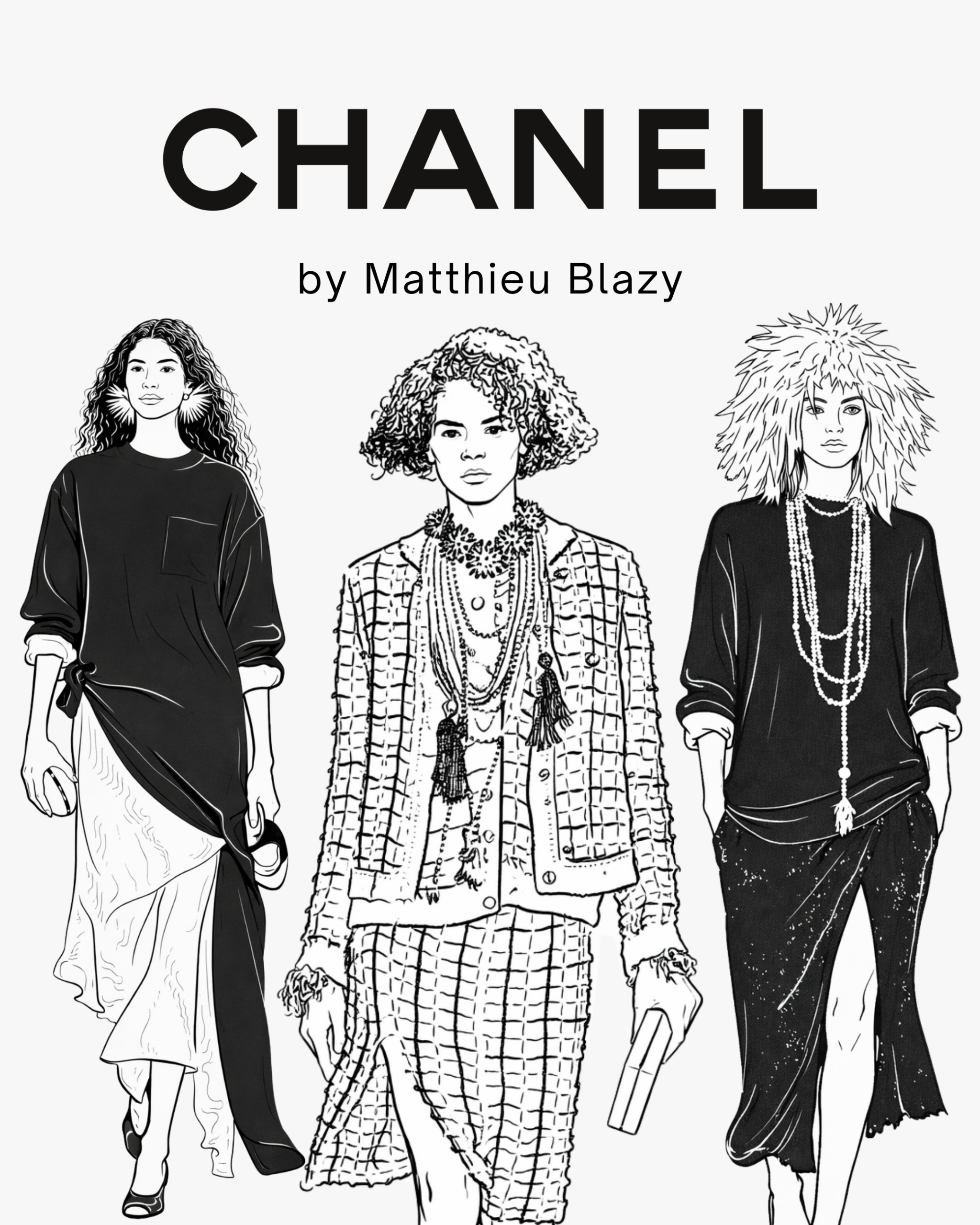
So what has Chanel become under Matthieu Blazy? Shocking! Seeing the house in such an intellectually avant-garde guise felt unfamiliar at first, yet unexpectedly refreshing. There was minimal logo display, a rich interplay of colors and textures, and Blazy’s signature trompe-l’œil effects: “visible underwear” that turned out to be nothing more than elastic stitched to the waistband of skirts and trousers; frayed threads along hems and jacket edges that, upon closer inspection, revealed themselves to be intricate beadwork.
Blazy clearly had something to say. Instead of offering standard backstage soundbites about inspiration, his thoughts unfolded in an extensive Vogue interview, tracing his journey from the first phone call inviting him to interview at Chanel to the philosophy behind his debut collection. He approached the concept with remarkable depth and respect for Gabrielle Chanel herself. The collection was loosely divided into three parts, each reflecting a stage of the founder’s life: the “masculine” wardrobe elements borrowed from her lover Boy Capel — padded-shoulder jackets and oversized shirts; references to her rural, working-class origins through wheat embroidery; and, of course, the house’s iconic codes — the little black dress, black-and-white tweed suits, and white looks accented with black stripes, directly echoing the packaging of the legendary Chanel No. 5. Blazy also retained his fondness for fringe, which at Chanel transformed into a new interpretation of the camellia, appearing across skirts, whimsical headpieces, and bold accessories.
Blazy has never sought to reshape the female body. On the contrary, his clothes serve the woman wearing them, allowing her to move freely, almost as if floating alongside her. This philosophy closely echoes that of Gabrielle Chanel herself, who famously liberated women’s fashion through comfortable, corset-free jersey garments. Despite the presence of more experimental elements — such as sheer skirts and dresses — the collection ultimately felt deeply Chanel. All the codes, silhouettes, and color combinations are legible even without logos, yet they appear modern and clear. And isn’t that, ultimately, the greatest achievement a creative director can claim in a house with such a legacy?